
Why 20 Years of Experience Makes AI Actually Useful
This business analyst's take on AI will help you succeed in your professional life


Welcome to week 3 of Think, Build, Brand, September edition. Today’s edition is for anyone who truly wants to use AI in all it’s powerful glory. We’ll learn the true value of AI systems from business analyst .
From Farida:
I've spent two decades as a business analyst and data engineer, working in the trenches of economics and finance. In my newsletter, Lights ON, I try my best to demystify and simplify the how-to of themes and topics that matter in business, technology, and life. This article is no different.

It's a good time to be an AI tool developer. It seems like everyone is jumping on the bandwagon, ready to invest time and money into the next big thing. But I'm concerned. Most people are following trends without a purpose, without understanding the core fundamentals of their market, their business, or their customers.
Success isn't about having a good idea or a good attitude. It's about navigating the complex business terrain. AI can help you, but only if you know how to drive it.
The Map and Compass for Your Journey
Before you even think about using AI, you need a map and a compass. This is where your business fundamentals come in.
Understand Business as a System: A business isn't a trend or a standalone idea. It's a system, an interconnected set of elements that is coherently organized to achieve a purpose. AI is a powerful tool for analyzing a system, but it can't tell you how the parts should be connected.
The quality of your results depends on your understanding of the whole picture. As a Sufi teaching goes: "You think because you understand 'one' that you must therefore understand 'two' because one and one make two. But you forget that you must also understand 'and'."
The 'and', the interconnections, the context, the relationships, is where true value is created.
Purpose as Your North Star: AI gives you a universe of potential, but without a clear business purpose, you'll get lost and waste resources. Purpose is not an idea; it's a living guide deduced from your behavior and your metrics.
If you are not conscious of your true purpose, AI can steal your time, money, and dreams by leading you down countless paths that look promising but go nowhere.
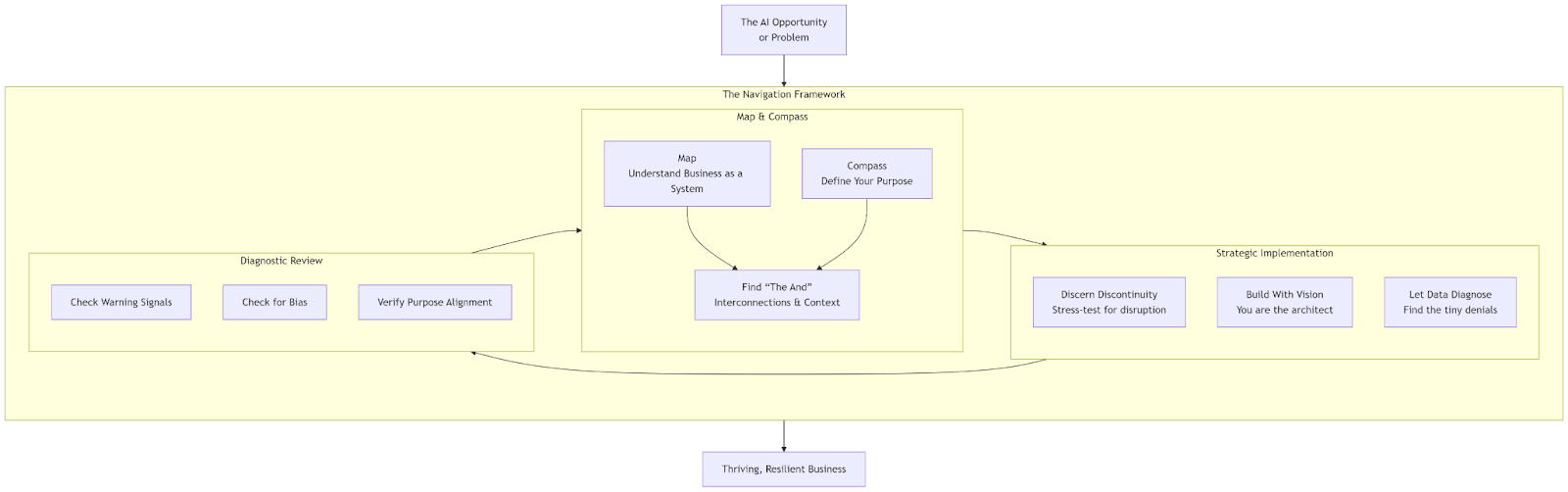
The Pathway to Thriving with AI
Once you have your map and your compass, you can begin to use AI not as a shiny new toy, but as a strategic tool to build a resilient and profitable business. This isn't about AI replacing expertise; it's about making your already solid work exceptional by teaching AI to work with you.
Discern Discontinuity, Don't Just Follow Trends: AI is a systematic pattern-recognition tool. It excels at showing you what's happened and what's likely to happen if everything stays the same.
But business is rooted in disruption. A market shock, a new competitor, or a sudden technological shift won't show up in a trend analysis. Your business must be able to adapt, mend injuries, and attend to survival.
Use AI to run "what-if" scenarios and stress-test your plans against sudden breaks in the pattern, rather than just using it to predict a predictable future. Remember, success is not just about identifying patterns; it's about navigating when those patterns break.
Build with a Vision, Not Just a Tool: Success is not about a tool; it's about the vision behind it. A skilled professional doesn't use AI to write a story; they use it to enhance their storytelling, much like Daria's systematic approach to AI-powered writing.
A writer might use AI to generate new ideas, defeat writer's block, or refine their language, but they remain the architect of the narrative. Similarly, you must remain the architect of your business. Use AI to enhance your operations and amplify your expertise, not to replace your vision.
For example, as a business analyst, you can leverage AI to:
Stress-test assumptions in complex financial models.
Identify inconsistencies and vulnerabilities in technical documents or security frameworks.
Cross-reference intricate regulatory requirements across diverse international jurisdictions.
Systematically analyze how cybersecurity investments impact financial outcomes, connecting disparate domains.
Let Data Be Your Diagnostician: Failure doesn't come out of the blue; it's a compilation of tiny, ignored signals.
AI can help you analyze metrics to diagnose these "tiny denials" in your purpose or process. This shifts the view of data from "what will happen" to "what is going wrong now." Instead of a single metric showing a decline in customer engagement, AI can help you surface the hundreds of micro-interactions and feedback points that led to the decline, providing actionable insights for course correction.
This discerning of truth depends mostly on your purpose, what are you truly trying to achieve?
A Framework for Strategic AI Implementation
Here's how to apply this thinking to any AI opportunity you encounter. Let's use a real example:
Before (Hype-Driven Thinking): "Everyone's using AI chatbots for customer service. We should build one too. It'll save costs and look innovative."
After (Purpose-Driven Analysis):
Map: What's our current customer service system? How do inquiries flow? What are the actual pain points?
Compass: What's our true purpose? Is it cost reduction, customer satisfaction, or competitive positioning?
The "And": How does customer service connect to retention, upselling, brand perception, and operational efficiency?
Discontinuity Test: What happens if our chatbot fails during a crisis? How do we maintain human connection when customers need empathy?
Diagnostic Data: What micro-signals indicate customer service is working or failing beyond response times?
Result: Instead of a generic chatbot, you might discover you need an AI system that routes complex issues to specialized humans while handling routine inquiries, or you might find that your real problem isn't response speed but inconsistent information across channels.
A Framework for Monetizing AI Tools
If you're building AI products, this same framework guides you to a purpose-driven, value-centric approach that transcends the hype.
Step 1: Define Your Purpose (The "Why") Before you build a single feature, ask yourself: What is the core problem my AI is solving? The most common mistake is building an impressive tool and then searching for a problem. Instead, define the specific pain point and how your AI alleviates it. Your purpose is the foundation of your business. Without it, you will get lost.
Example: Don't just build an "AI content generator." Build an "AI tool that helps marketing teams produce SEO-optimized blog posts 50% faster." The purpose is specific and measurable.
Step 2: Choose Your Business Model (The "How") Your business model should align with the value you create, not just the technology you use. There are several models you can adopt, each with pros and cons.
Freemium: Offer a basic, non-monetized version to get widespread adoption. This works well for simple tools where you can easily "gate" premium features like unlimited usage, advanced capabilities, or custom integrations.
Subscription: Charge a flat monthly or annual fee. This provides predictable revenue and is ideal for tools that become part of a user's regular workflow. You can use tiers to segment customers based on features or usage.
Usage-Based: Charge customers based on their consumption (e.g., per API call, per query, per report generated). This is great for tools with high infrastructure costs, as it directly aligns your revenue with your expenses.
Outcome-Based: Charge customers based on a specific, measurable result (e.g., a percentage of cost savings, a fixed fee for each lead generated). This is the most complex model to implement but can command the highest price because you're monetizing the direct business value you provide.
Step 3: Discern Value Metrics (The "What") This is where you apply the "and." The metrics you track should go beyond simple usage and connect to the purpose of your business. Your success metrics should be what your customers value.
Align your metrics with business outcomes. If your tool helps with sales, don't just track how many reports a user runs; track how many new leads they convert. If your tool streamlines customer service, track metrics like average resolution time or customer satisfaction scores, not just the number of tickets processed.
Use data to diagnose, not just predict. Instead of simply forecasting revenue, use AI to analyze why certain metrics are declining. Your tool can help you identify the "tiny denials" in your business process that are leading to a larger problem.
By following this framework, you'll be building a business that can navigate the complex terrain of the AI market with purpose and resilience.
Your Navigation Checklist
Before implementing any AI solution, ask yourself:
Map Questions:
What's the current system and how do all the parts connect?
Where are the real bottlenecks versus perceived problems?
Compass Questions:
What's my actual purpose here (not what I think it should be)?
How will I measure if this AI implementation serves that purpose?
"And" Questions:
How does this AI change the relationships between different parts of my business?
What second and third-order effects might I be missing?
Discontinuity Questions:
What happens when this AI fails or when the patterns it learned no longer apply?
How do I maintain strategic advantage when competitors have the same tools?
Diagnostic Questions:
What early warning signals will tell me this isn't working as intended?
How do I separate AI-generated insights from AI-amplified biases?
Final Takeaway: The Human Behind the Machine
The core insight is this: AI works best when you already understand the fundamentals of your territory. Most people struggling with AI are trying to use it to replace knowledge they don't have, rather than enhance knowledge they do have. They see AI as a shortcut to expertise rather than a tool for systematic analysis.
AI is an incredible tool, but it's not a substitute for human wisdom, purpose, and fundamental business knowledge. The ultimate success lies in the synergy between a powerful tool and an intentional human. By focusing on your business fundamentals, you can harness the power of AI to build a resilient business that serves your dreams, not steals them.
The professionals who will thrive aren't those who embrace AI uncritically or those who reject it entirely. They're those who use it strategically, with clear purpose, solid fundamentals, and the wisdom to distinguish between what's technically possible and what's commercially valuable.
 | A guest post by
|
You've hit on so many key points crucial for a company's success. I completely agree: those who thrive with AI will be the ones who use it strategically and with purpose.
This is where the AI/Human collaboration comes in. By blending the deep, nuanced experience of a seasoned professional with a quarter-century of tech and business acumen, we can leverage AI's raw power to do the heavy lifting—handling data analysis and research with incredible speed. This dynamic partnership is what turns a good strategy into a great one.
This is the crucial message about AI that often gets lost: it's a power-up for deep expertise, not a substitute for it. Seeing this principle in action is what led me to create The Efficiency Playbook, where I explore similar topics. https://efficiencyplaybook.substack.com/